 RELEONE
Glacial Curing Brine
The liquid the house cures in — Icelandic glacial water and sea salt — concentrated, bottled, and offered plainly, for the home cure.

In motion.
Glacial Curing Brine.
A cure is two decisions: the fish, and the liquid it rests in. Releone cures in one brine. The water is Icelandic glacial meltwater, filtered on its long passage to the coast through volcanic basalt, and it carries the mineral signature of that passage. The salt is unrefined sea salt. There is nothing else in it. This bottle is that brine, concentrated for the shelf: cut one part to eight parts cold water and you are holding the working medium of the house — the same liquid, the same salinity, that every Releone jar passes through before it is sealed. It is offered as a pantry item for the home cure: fish, poultry, vegetables, citrus. The house publishes its own curing medium because provenance that stops at the fish is incomplete.
What it gives the table.
- The working medium of every Releone cure — the same brine, the same salinity, bottled without alteration.
- Icelandic glacial meltwater, basalt-filtered, with naturally occurring minerals: magnesium, calcium, potassium.
- Unrefined sea salt: no anti-caking agents, no additives, no nitrites, no sugar.
- Concentrate: one part brine to eight parts cold water makes roughly four and a half litres of working brine per bottle.
- For the home cure: a delicate brine for fish, poultry, vegetables, and citrus.
- Naturally vegan, gluten-free.
- OU certification pursued.
Nutrition facts.
Calories0
At the 1:8 working dilution, sodium is approximately 160 mg per 15 mL of finished brine.
What is in the bottle.
- Icelandic glacial meltwater (basalt-filtered)
- Unrefined sea salt
- Naturally occurring minerals (magnesium, calcium, potassium)
At $18, what the price represents.
Choose your edition.
Founder Edition reservations open September 15, 2026. Standard catalogue reservations open at public launch, Q3 2027.
Join the waitlist →The film and the label.
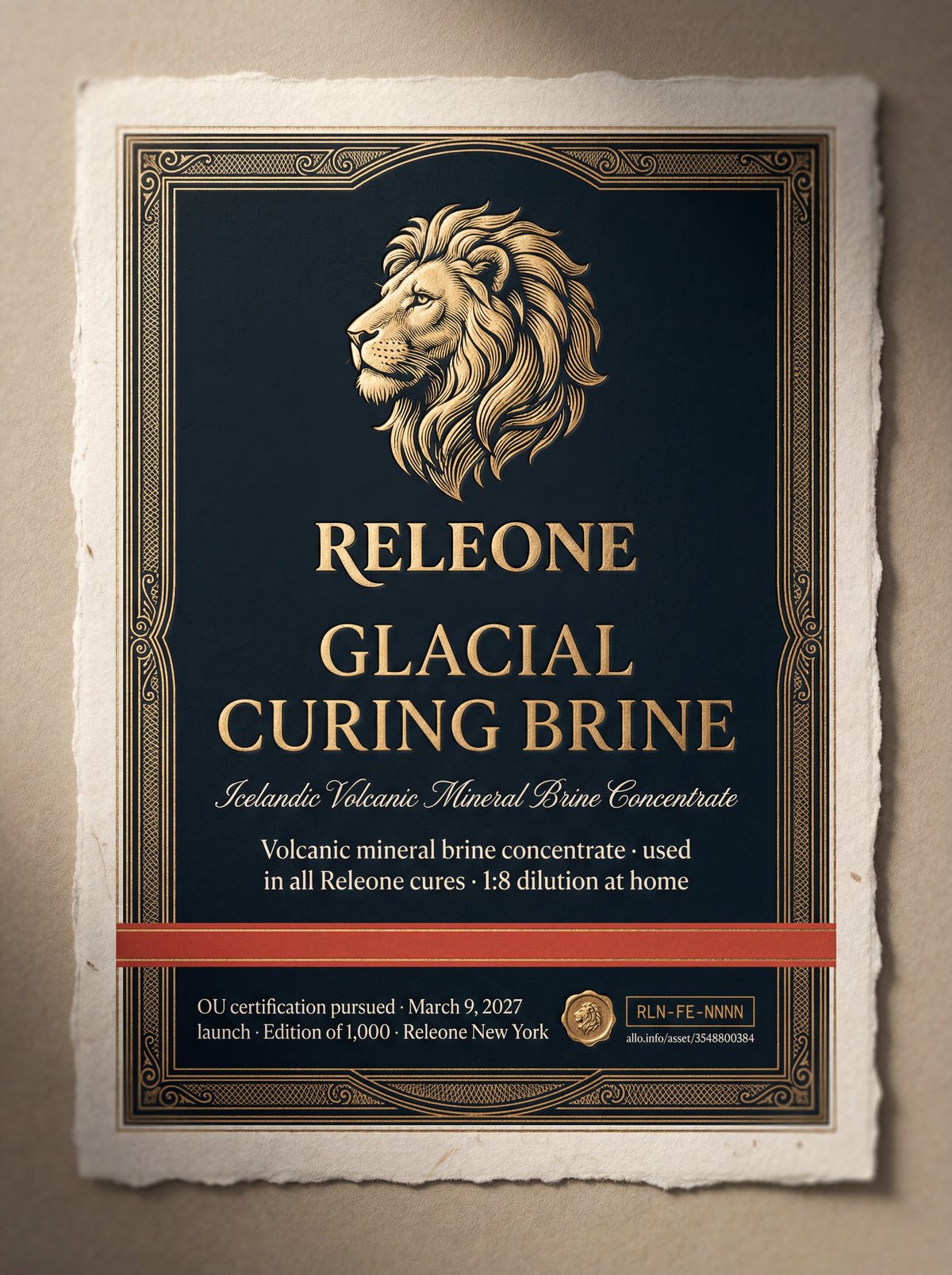
No models, no narration, no on-screen text inside the film. The label is where the words go. See all fifteen films at /films/.